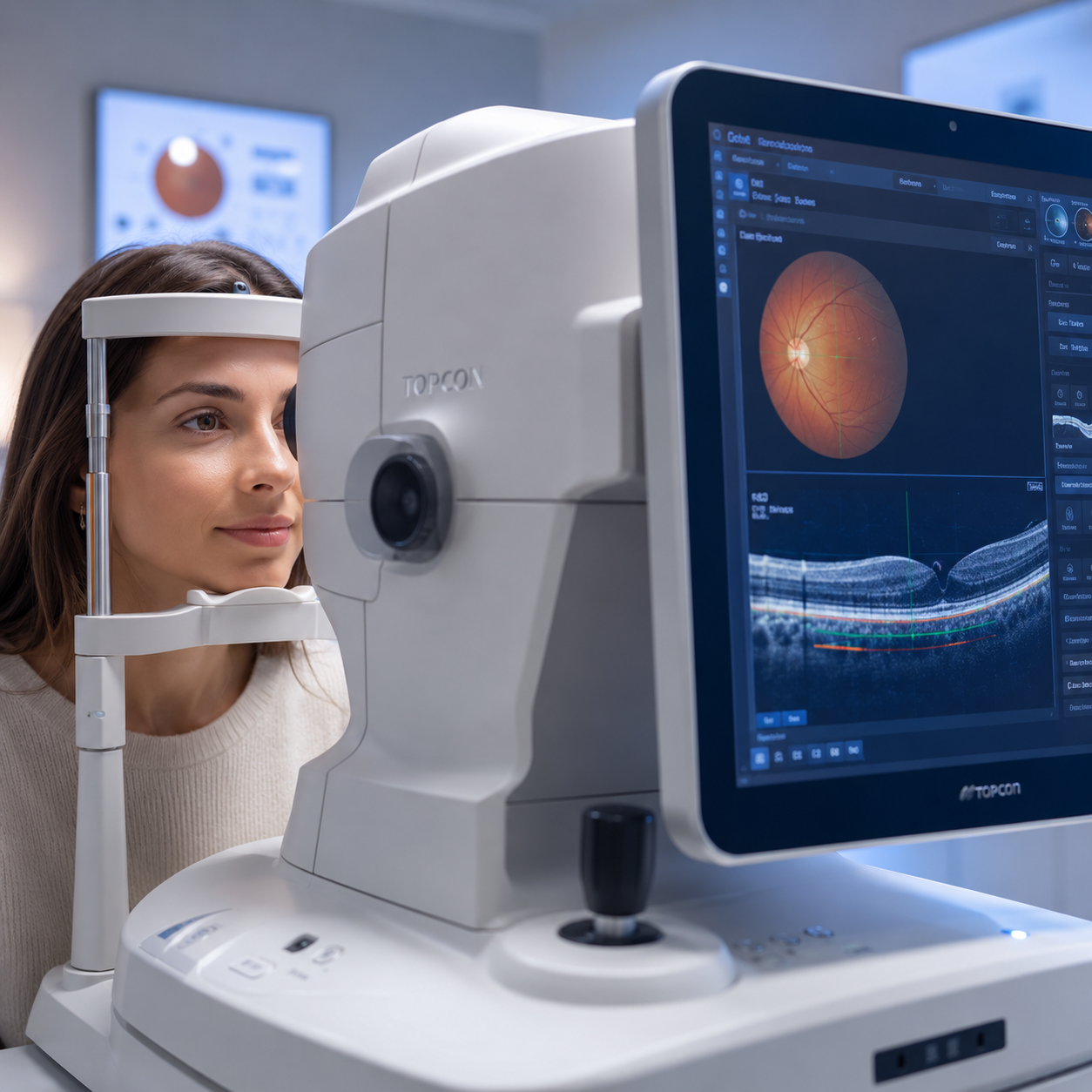
Retina Care
Your retina is the tissue at the back of your eye that converts light into the signals your brain reads as sight. When the retina is damaged, partial or total vision loss can follow. Vision Care of Maine treats retinal disease at multiple locations.
How Your Retina Works
Your retina is a membrane at the back of your eye that converts light into signals. Your brain reads those signals as sight. The retina is one of the most important parts of your eye. If it gets damaged, partial or total blindness can follow.
The retina has a layer of cells called photoreceptors. Rod photoreceptors perceive motion and help you see in low light. Cone photoreceptors give you central vision and color vision in medium to bright light. Millions of these cells live in your retina.
Here’s how it works: light passes through your cornea and lens, hits your retina, and gets converted into electrical signals. The optic nerve sends those signals to the visual cortex of your brain, which turns them into the images you see.
Common Retinal Diseases
There are many types of retinal diseases. Some are tied to aging. Others come from diabetes or other health conditions. Here are the most common ones we treat at Vision Care of Maine.
Diabetic Retinopathy
Patients with diabetes can develop damage to the blood vessels in the retina. If left untreated, diabetic retinopathy can eventually cause blindness. Patients with uncontrolled blood sugar are at the highest risk.
Age-Related Macular Degeneration (AMD)
AMD causes vision loss that often gets worse with age. It’s the leading cause of permanent vision loss for people 60 and older. Catching it early gives us the best chance of slowing it down.
Retinal Vasculitis
Inflammation of the retinal blood vessels. Damage to these vessels can lead to minimal, partial, or total blindness.
Uveitis
Inflammation that affects the middle layer of the eye (the uvea). Undiagnosed or untreated uveitis can lead to permanent vision loss.
Vitreous Hemorrhage
Bleeding into the vitreous cavity of the eye. May happen from abnormal blood vessels that are prone to bleeding, normal vessels that burst under stress, or bleeding from another source like a tumor or microaneurysm.
Macular Edema
Fluid buildup in the macula, the center of the retina. Common symptoms include wavy central vision, washed-out colors, and difficulty reading.
Retinal Detachment
The retina pulls away from the back of the eye. This is a medical emergency. If you have sudden flashes, floaters, or a curtain of darkness in your vision, call us immediately.
Symptoms of Retinal Disease
Many retinal diseases share the same symptoms. Watch for:
- Vision loss. Sudden or gradual loss of sight in one or both eyes.
- Blurred or distorted vision. Straight lines may look wavy or bent.
- Floaters. Cobwebs, spots, or specks drifting across your vision.
- Flashes. Brief flashes of light, often in your peripheral vision.
- Defects in side vision. Loss of vision in part of your visual field.
- A curtain or shadow. A dark area moving across your vision can signal retinal detachment.
If you suddenly develop floaters, flashes, or reduced vision, contact us right away. These can be signs of a retinal emergency that needs immediate care.
Retina Health Self-Test
Answer these 6 questions to see if you should schedule a retina evaluation. This is a screening tool, not a diagnosis.
1. Have you noticed new floaters, spots, or “cobwebs” in your vision recently?
2. Do you see flashes of light, especially in your peripheral vision?
3. Do straight lines look wavy, bent, or distorted to you?
4. Do you have diabetes?
5. Are you 60 years of age or older?
6. Has anyone in your family had macular degeneration or another retinal disease?
What Causes Retinal Disease?
Each retinal disease has different causes. Some conditions, like macular degeneration, are related to aging. Others stem from diabetes or other health issues. Trauma to the eye can play a part. Family history matters too.
The good news is that many retinal diseases can be managed or treated, especially when caught early. The key is regular eye exams.
How We Diagnose Retinal Disease
Your doctor will ask about your symptoms, other health conditions, and family history. We’ll then examine your eyes using one or more of these tests:
Amsler Grid Test
A simple grid pattern test that helps detect distortions in central vision.
OCT Imaging
Optical Coherence Tomography creates cross-section images of the retina.
Fluorescein Angiography
A dye-based test that maps blood flow in the retina.
Ultrasound
Used when the retina can’t be seen directly, like with vitreous hemorrhage.
How We Treat Retinal Disease
Most retinal diseases can be treated. The goal of treatment is often to slow the disease and preserve the vision you have. In some cases, complete vision restoration may be possible. Each case is different, so treatment depends on your specific disease and your eyes.
Common treatment options include:
- Intravitreal injections. Medicine injected directly into the eye to slow disease progression.
- Laser surgery. Used to seal leaking blood vessels and treat retinal tears.
- Cryotherapy. Freezing technique used to repair retinal tears and detachments.
- Vitrectomy. Removing and replacing the gel-like fluid in the eye.
- Anti-VEGF medications. Injected medications that target abnormal blood vessel growth.
- Scleral buckle. A small band placed around the eye to support a detached retina.
Your retina specialist will explain which option is right for your situation.
Keep Your Retina Healthy
The best way to care for your retina is to be proactive. Don’t wait until you notice symptoms. Schedule a yearly comprehensive eye exam, especially if you have diabetes, high blood pressure, or a family history of retinal disease.
Not sure when your last eye exam was? Let our team help. Schedule an appointment at any Vision Care of Maine location.
Retina Specialists
Our doctors specialize in retinal disease diagnosis and treatment.



Locations Offering Retina Care
Schedule a Retina Evaluation
If you have symptoms of retinal disease or you’re due for your annual eye exam, our retina specialists are here to help. Call today to schedule.